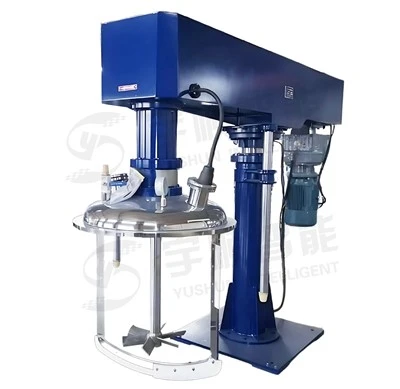
Stirring Is An Extremely Important Step in The Lithium Battery Slurry Preparation Process!
Oct 23, 2023
Since the 1970s, lithium-ion batteries have gradually gained favor as a new type of energy storage battery and developed rapidly. Power lithium-ion batteries have the advantages of high energy density, high number of cycles, long life, low energy consumption, low pollution, no memory effect, small self-discharge, low internal resistance, and high cost performance. They are widely used in mobile phones, laptops, electric vehicles, In aerospace and other fields, at the same time, there are also shortcomings such as poor safety performance and poor consistency of single cells. Among them, single battery consistency is a key indicator to measure the performance of power lithium-ion batteries.
Due to market demand, power lithium batteries are mostly used in groups, and the requirements for product consistency are much higher than those for ordinary consumer electronics. Therefore, the lithium-ion battery production process needs to be more strictly controlled, that is, the lithium-ion battery production process and Equipment requirements are higher, thereby ensuring that the single cells produced are highly consistent.
The production process of lithium-ion batteries mainly includes: slurry preparation, coating, rolling, tableting, winding, liquid injection, formation, volume separation, testing, packaging, etc. Each process will affect various performance indicators such as battery consistency and safety. As the first step in lithium-ion battery production, the importance of slurry preparation cannot be underestimated.
In the electrode manufacturing of lithium-ion batteries, the main requirement for the battery slurry is: uniform dispersion. If the slurry is unevenly dispersed, serious agglomeration will occur, which will ultimately have a great impact on the electrochemical performance of the battery core. ; Secondly, the slurry must have good settlement stability and rheological properties, meet the requirements of the pole piece coating process, and obtain a coating with uniform thickness through coating. Therefore, choosing the appropriate mixing process is crucial for the production of lithium-ion batteries.
At present, the mixing process of electrode slurry is divided into two types: wet mixing and dry mixing: the wet pulping process is widely used in the domestic lithium-ion battery industry. In recent years, some manufacturers have begun to carry out dry mixing. Material experiments revealed that dry mixing has more advantages. In the wet mixing process, the dual planetary vacuum mixer is generally selected as the mixing equipment for mainstream lithium-ion battery slurry.
In the lithium-ion battery manufacturing process, traditional pulping equipment is mainly based on planetary mixers. According to the number of mixing shafts, they can be divided into single-shaft mixers, double-shaft mixers, three-shaft planetary mixers, etc. Bi-shaft and tri-shaft stirring can be used to stir and mix viscous materials. At present, the independent dual-axis design is mostly used on the market.