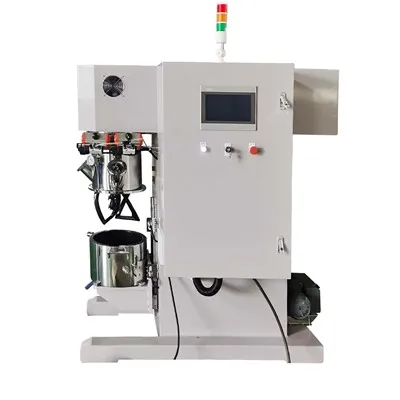
Development and working principle of horizontal bead mill
Jul 28, 2022
Horizontal bead mill is a kind of ultra-fine particle dispersing machine for horizontal wet continuous production.
The pre-stirred raw materials are sent into the grinding tank of the main machine, and the grinding tank is filled with an appropriate amount of grinding media, such as Zirconium beads, which rotate at high speed through the dispersing blades, giving the grinding media enough energy to collide with the dispersed particles to generate shear force. To achieve the effect of dispersion, and then through a special separation device, the dispersed material and the grinding media are separated and discharged.
Because there is no need to operate like three roller mill, you can get good quality, and can be continuously produced in large quantities.
Therefore, it can improve the quality and reduce the cost, and it is also suitable for the dispersion of high-viscosity substances, so it can be used in industries such as paint, ink, medicine, food, cosmetics, and pesticides.
In the chemical industry, dispersion engineering has always been an important part. Including coatings, paints, inks, dyes, printing, pesticides, etc. must be used in dispersion engineering, and the main function of dispersion is to disperse solid particles in a liquid medium. Generally, the so-called dispersion actually includes three stages:
(1) Wetting; that is, replacing the gas adsorbed on the surface of solid particles with liquid.
(2) Grinding; the agglomerated particles are broken into original particles by mechanical force.
(3) Dispersion; it is to move the wetted raw material particles into the liquid medium to produce lasting particle separation.
The traditional dispersing and grinding machinery has always been dominated by three roller mill and ball mills. Since 1952, the vertical bead mill invented by DuPont in order to improve the slow production of traditional ball mills has entered a new era.
Until 1966, European scientists researched and developed a horizontal bead mill in order to further improve the shortcomings of vertical bead mills, such as difficult color changing, glass beads deposited at the bottom when stationary, and difficult to start, and the beads are fragile. In addition to the advantages, it adopts a forced separation automatic cleaning device, which improves the filling rate of grinding beads, and has the advantages of no pollution, energy saving, no noise, and easy color change.